


 admin
admin

Outdoor areas need materials that can withstand changing weather, regular foot traffic and everyday use without requiring constant maintenance. Wood plastic composite, commonly known as WPC, has become a popular option for residential and commercial decking because it combines wood fibres with modern plastic technology.
For homeowners researching composite decking Melbourne, understanding how WPC decking is manufactured can make it easier to compare products. The quality of the raw materials, production method, board structure and protective surface all influence how the decking looks, performs and ages after installation.
What Does WPC Decking Mean?
WPC stands for wood plastic composite. It is an engineered material produced by combining wood fibres or wood flour with thermoplastic polymers and performance-enhancing additives.
Unlike traditional timber boards, WPC decking is not cut directly from a tree. Instead, the material is mixed, heated and shaped into boards through a controlled industrial manufacturing process. This allows manufacturers to create decking with consistent dimensions, colours, textures and structural profiles.
WPC decking commonly contains:
- Recycled or responsibly sourced wood fibres
- Wood flour from sawmills or reclaimed timber
- Recycled or virgin plastic
- Binding or coupling agents
- Colour pigments
- UV stabilisers
- Lubricants and processing aids
- Additives that support resistance to moisture and surface wear
Common plastics used in WPC production may include high-density polyethylene, also known as HDPE, polypropylene or PVC. The exact material formulation varies depending on the manufacturer and the type of board being produced.
Why Is WPC Used for Outdoor Decking?
Timber remains a familiar decking material, but it may require regular sanding, oiling, painting or staining. Natural timber can also be affected by splintering, moisture movement, cracking and uneven weathering.
WPC decking is designed to reduce many of these maintenance concerns while maintaining a timber-inspired appearance.
Common benefits include:
- No regular painting, staining or oiling
- Lower ongoing maintenance requirements
- Consistent colour and board dimensions
- Reduced likelihood of splintering
- Resistance to normal outdoor moisture exposure
- A choice of colours and woodgrain finishes
- Suitability for homes and selected commercial projects
- Use of recycled wood and plastic in many products
WPC decking is still not completely maintenance-free. Leaves, dirt, spills and organic material should be removed regularly. Correct ventilation, drainage, board spacing, subframe construction and compatible fasteners are also essential.
How WPC Decking Is Manufactured
The production of WPC decking follows a precise and highly controlled industrial process. Although the exact recipe and equipment may differ between manufacturers, most WPC boards are made using the following stages.
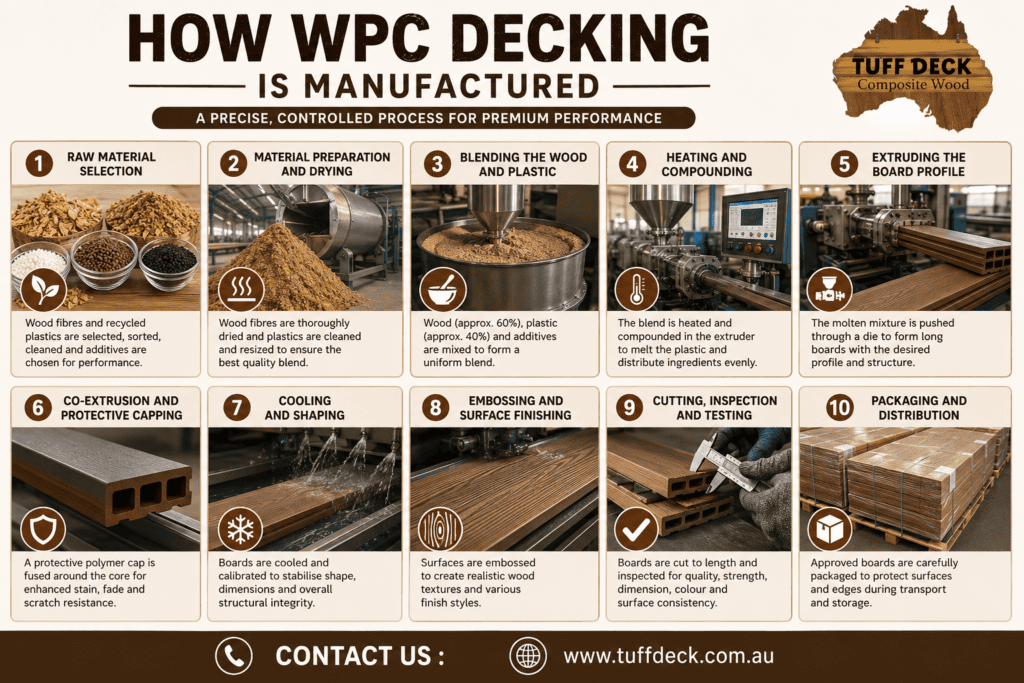
1. Raw Material Selection
The process begins with selecting suitable wood and plastic materials.
Wood content may come from:
- Sawmill residues
- Reclaimed timber
- Wood flour
- Fine wood fibres
- Other responsibly sourced wood by-products
The plastic component may include recycled HDPE, PVC or polypropylene. Materials must be sorted and cleaned to reduce contamination and maintain consistent production quality.
Manufacturers also select pigments, UV stabilisers, binding agents, lubricants and other additives according to the required colour, surface finish and performance characteristics of the finished board.
2. Material Preparation and Drying
Wood fibres and wood flour naturally contain moisture. Before the ingredients can be combined, the wood material must be thoroughly dried.
Excess moisture can create steam during extrusion, potentially causing:
- Internal air pockets
- Surface bubbles
- Structural inconsistencies
- Weak bonding between wood and plastic
- Irregular board dimensions
The wood fibres are therefore dried to a controlled moisture level. Recycled plastics are also cleaned, processed and reduced to a suitable particle size so that they can melt and blend evenly.
Proper material preparation is one of the most important stages because inconsistent raw materials can affect the appearance and strength of the final decking board.
3. Blending the Wood and Plastic
Once the materials are prepared, the wood fibres and plastic are measured and combined.
A commonly used formulation is approximately:
- 60% wood fibre or wood flour
- 40% plastic and additional performance ingredients
However, this ratio is not universal. Different manufacturers may use different proportions depending on their product design, extrusion equipment and performance requirements.
During blending, manufacturers may add:
- Binding or coupling agents
- UV stabilisers
- Colourants
- Lubricants
- Mould-resistant additives
- Processing aids
Binding agents help the wood and plastic components connect more effectively. UV stabilisers support colour retention during outdoor exposure, while lubricants help the material move smoothly through the manufacturing equipment.
For customers considering eco decking Melbourne, it is worth asking how much recycled material is used and where the product is manufactured. Sustainability should be evaluated alongside lifespan, maintenance needs, transportation and product performance.
4. Heating and Compounding
The blended ingredients are fed into industrial compounding or extrusion machinery.
Inside the machine, controlled heat softens and melts the plastic component. Rotating screws continuously mix the material, distributing the wood fibres, pigments and additives throughout the softened polymer.
Temperature control is essential. If the mixture is not heated sufficiently, it may not blend or flow correctly. Excessive heat may damage the wood fibres or affect the stability of the finished product.
The result is a thick, uniform wood-plastic mixture that is ready to be shaped.
5. Extruding the Board Profile
The heated composite mixture is pushed through an extruder die. The die acts as a mould, forming the material into a long, continuous decking board.
The extrusion die determines the board’s:
- Width
- Thickness
- Edge shape
- Groove design
- Internal structure
- Overall profile
WPC decking may be produced as either solid or hollow boards.
Solid boards contain composite material throughout their cross-section. Hollow boards contain internal chambers, which may help reduce board weight and material usage. Some boards also have grooved edges designed to work with hidden fixing clips.
The best profile depends on the intended installation, subframe, expected traffic and manufacturer’s recommendations.
6. Co-Extrusion and Protective Capping
Higher-end WPC boards may undergo an additional process known as co-extrusion.
During co-extrusion, a protective polymer cap is fused around the wood-plastic core while the board is being manufactured. This outer layer acts like protective armour around the composite material.
A capped or co-extruded surface may provide improved resistance to:
- Stains
- Colour fading
- Scratches
- Moisture
- Everyday surface wear
- Food and drink spills
Some boards are capped on the top and sides, while others may be protected on all four sides. The level of coverage depends on the product.
Uncapped boards do not have a separate protective shell. They can still provide reliable performance, but their stain resistance, fading characteristics and cleaning requirements may differ.
7. Cooling and Shaping
When the decking board exits the extrusion die, it is still hot and flexible. It must be cooled carefully so it retains the intended shape and dimensions.
The continuous boards may pass through:
- A cooling water bath
- A controlled water-spray system
- An air-cooling tunnel
- Calibration equipment
Cooling solidifies the composite material and stabilises the board profile. Calibration tools may also be used to maintain consistent width, thickness and edge alignment.
8. Embossing and Surface Finishing
After cooling, the decking surface may be embossed to create a natural woodgrain or textured finish.
Manufacturers can produce different surface styles, including:
- Deep woodgrain patterns
- Brushed textures
- Fine-grain finishes
- Reversible board designs
- Contemporary linear patterns
Texturing is not only decorative. It may also contribute to the feel and surface grip of the board, although buyers should always check the product’s documented slip-resistance information for wet or poolside areas.
9. Cutting, Inspection and Packaging
The continuous decking boards are cut into standard or customised lengths.
Before packaging, quality-control inspections may check:
- Board dimensions
- Surface consistency
- Colour uniformity
- Profile shape
- Edge quality
- Visible defects
- Structural performance
Depending on the manufacturer, additional testing may assess strength, moisture absorption, impact performance, weather resistance and dimensional stability.
Approved boards are then packaged to protect their surfaces and edges during transport and storage.
What Happens After Manufacturing?
Even a well-manufactured WPC board must be stored and installed correctly. Boards should generally be kept flat and adequately supported before installation.
Installers must follow the manufacturer’s requirements for:
- Joist spacing
- Subframe materials
- Ventilation
- Drainage
- Expansion gaps
- Board-end spacing
- Starter clips and hidden fixings
- Fascia and edge finishing
Poor installation may cause movement, water retention or uneven boards, regardless of the product’s manufacturing quality.
How to Choose Quality WPC Decking
Buyers should avoid choosing decking based only on price or colour.
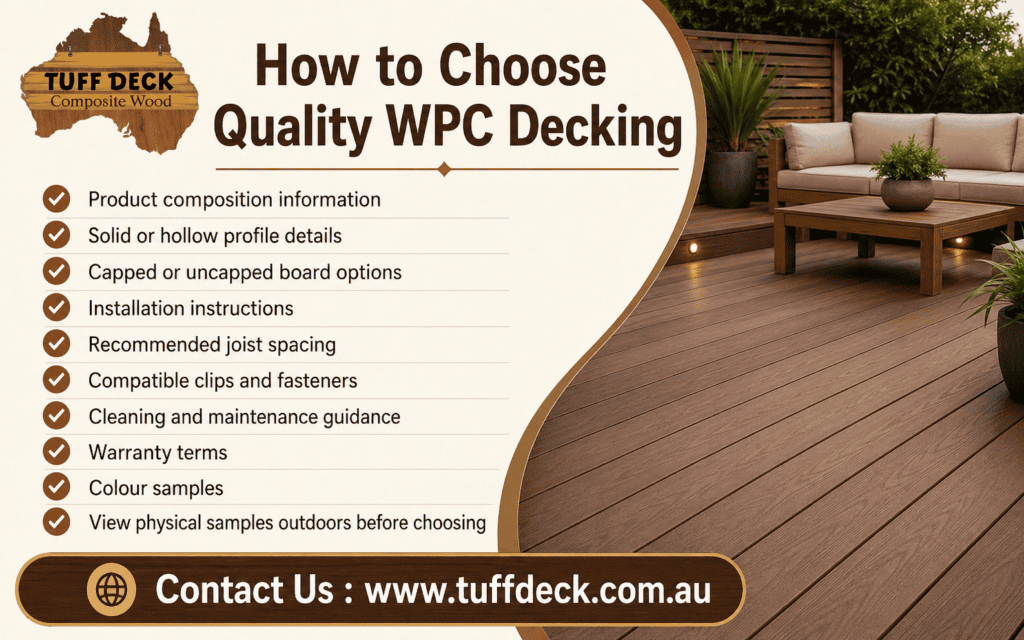
Before ordering, ask the supplier for:
- Product composition information
- Solid or hollow profile details
- Capped or uncapped board options
- Installation instructions
- Recommended joist spacing
- Compatible clips and fasteners
- Cleaning and maintenance guidance
- Warranty terms
- Colour samples
It is also advisable to view physical samples outdoors, as colours and textures can appear different under natural light.
Is WPC Decking Environmentally Responsible?
WPC decking can support more efficient material use because many products incorporate recycled plastics and wood by-products that might otherwise become waste.
Its long service potential and reduced need for paints, stains and oils can also make it an attractive option for lower-maintenance outdoor projects.
However, environmental performance should be considered across the entire product lifecycle. Manufacturing location, recycled content, transport distance, expected lifespan, maintenance requirements and end-of-life options should all be considered.
Why Choose a Tuff Deck?
Tuff Deck is a Melbourne-based Australian manufacturer supplying composite decking, fencing, screening, wall cladding and compatible installation accessories for domestic and commercial applications. The company focuses on locally manufactured WPC products, customised sizing, practical technical support and solutions designed for durability, affordability and visual appeal.
When comparing decking suppliers Melbourne, working with a local manufacturer can provide valuable assistance with board selection, profiles, colours, fasteners and installation requirements.
Conclusion
WPC decking is manufactured by drying and preparing wood fibres and plastics, blending them with specialised additives, heating the mixture and extruding it through a shaping die. Higher-quality boards may also receive a co-extruded protective cap before being cooled, embossed, cut, inspected and packaged.
Understanding this process allows homeowners, builders and designers to compare WPC decking products based on construction quality, protective features, installation requirements and long-term value rather than appearance alone.